Silhouette Facelift in Abu Dhabi
Collagen loss begins in the mid-20s and accelerates with every decade that follows. By the time visible sagging appears, the underlying structural support of the face has already changed significantly. The Silhouette Facelift in Abu Dhabi addresses this directly, not by filling or relaxing, but by physically lifting and repositioning the tissue while simultaneously triggering the body's own collagen production. The result is an immediate lift that continues to improve over the following weeks, using an absorbable thread system that leaves no visible scars and requires minimal recovery.
Quick Facts
| Treatment Type | Non-surgical thread lift |
| Also Known As | Silhouette Soft, Silhouette InstaLift |
| Technology | Absorbable bi-directional cone sutures |
| Thread Material | PLLA (Poly-L-lactic acid) and PLGA |
| Regulatory Status | FDA cleared and CE marked |
| Procedure Time | 45 to 60 minutes |
| Anaesthesia | Local anaesthetic at entry and exit points |
| Downtime | Minimal |
| Scarring | No visible scars |
| First Results | Immediate lift visible at the end of the session |
| Full Results | 4 to 12 weeks as collagen remodelling progresses |
| Longevity | 12 to 18 months |
| Skin Type Suitability | All skin types |
| Starting Cost | 2,500 AED |
What Is a Silhouette Facelift?
The Silhouette Facelift, marketed under the names Silhouette Soft and Silhouette InstaLift, is a minimally invasive thread lift procedure that uses absorbable sutures fitted with bi-directional cones to lift and reposition sagging facial tissue without surgery.
Unlike dermal fillers, which add volume, or neuromodulators, which relax muscles, the Silhouette system physically repositions tissue. The bi-directional cones grip the tissue from multiple angles as the thread is positioned, creating an immediate mechanical lift. As the body absorbs the threads over the following months, it generates new collagen around the suture sites, producing a secondary tightening and firming effect that continues long after the thread itself has dissolved.
The procedure is performed under local anaesthetic, requires no general anaesthesia, and leaves no visible sutures or external scarring. It sits between injectable treatments and surgical facelifts in terms of both invasiveness and degree of correction, making it the appropriate option for patients whose concerns exceed what injectables can address but who are not ready for or interested in surgery.
How Does a Silhouette Facelift Work?
The mechanism of the Silhouette system operates on two levels simultaneously.
Immediate mechanical lift: The absorbable sutures are inserted beneath the skin using a needle. Each suture has bi-directional cones, small projections that face in opposing directions along the thread. When the specialist applies gentle manual compression to the skin after placement, the cones lock into the surrounding tissue from both directions, anchoring the lifted position in place. This is what produces the visible improvement immediately at the end of the session.
Progressive collagen stimulation: The thread material, PLLA (poly-L-lactic acid), combined with PLGA, is biocompatible and fully absorbable. As the body gradually breaks down the suture material over 12 to 18 months, it triggers a localised healing response. Fibroblasts migrate to the thread site and begin producing new collagen fibres. The skin becomes progressively firmer, more resilient, and better supported as this collagen matrix develops over the weeks and months following treatment.
The combination of immediate repositioning and long-term collagen stimulation is what distinguishes Silhouette from simpler thread lift systems.
Cost of Silhouette Facelift in Abu Dhabi
The starting cost of a Silhouette Facelift in Abu Dhabi is 2,500 AED. The final price depends on the number of threads required, the areas being treated, and the complexity of the lifting pattern needed for your facial anatomy. Patients treating a single zone, such as the jawline, require fewer threads than those addressing the full mid-face and lower face simultaneously.
An accurate, itemised quote is confirmed at consultation after your specialist has assessed your facial anatomy and treatment goals. All pricing is confirmed before any treatment begins.
Target Areas: Where Silhouette Soft Works Best
The Silhouette system can be applied across multiple zones of the face and neck. Treatment areas are selected based on where tissue descent and laxity are most visible in your specific anatomy:
| Area | Concern Addressed |
|---|---|
| Mid-Face and Cheeks | Descent of cheek fat pads creating flattened, heavy mid-face |
| Jawline | Softening of jawline definition and early jowl formation |
| Nasolabial Folds | Deepening smile lines caused by mid-face descent |
| Lower Face | Loss of lower face definition and facial proportion |
| Neck Area | Early neck laxity and platysmal loosening |
| Overall Facial Contours | Generalised facial descent affecting overall symmetry and profile |
Multiple zones are commonly treated in a single session. Your specialist will determine the most appropriate treatment pattern at the consultation.
How to Prepare for Your Silhouette Facelift Session
One Week Before Your Appointment
- Avoid blood-thinning medications and supplements, including aspirin, ibuprofen, fish oil, and vitamin E, for at least one week before treatment
- Stop smoking for at least one week before your session, as smoking impairs tissue healing and collagen production
- Avoid alcohol for 48 to 72 hours before your appointment
- Do not schedule other facial treatments, peels, laser, or microneedling in the two weeks before your thread lift
On the Day of Your Appointment
- Arrive with a thoroughly clean face, no makeup, moisturiser, or skincare products applied
- Eat a light meal before your appointment
- Wear comfortable clothing that does not need to be pulled over your head after the procedure
- Inform your specialist of any changes to your medications or health since your consultation
Silhouette Facelift Procedure: Step by Step
The full procedure takes approximately 45 to 60 minutes from preparation through to completion.
Consultation and Facial Assessment
Your specialist examines your facial anatomy, skin laxity, and the pattern of tissue descent specific to your face. Your aesthetic goals and concerns are discussed. The thread placement pattern, the number of sutures required, and the target lifting vectors are all determined at this stage and confirmed before treatment begins.
Mapping the Treatment Area
Entry and exit points for each thread are marked on the skin using a surgical pen. This mapping step is critical for symmetrical, proportionate results. The marks define the precise path each suture will follow beneath the tissue.
Local Anaesthetic
Local anaesthetic is administered to each entry and exit point. Once the anaesthetic has taken effect, the procedure is well-tolerated by most patients. You remain fully awake throughout. Discomfort during the procedure is minimal because the threads are placed in the subcutaneous fat layer, which has relatively few nerve endings.
Thread Placement
The specialist inserts each absorbable suture beneath the skin using a fine needle along the mapped path. The thread is placed in the subcutaneous layer, positioning the bi-directional cones precisely in the tissue that needs to be lifted and repositioned.
Lifting and Anchoring
Once each thread is in position, the specialist applies controlled manual compression to the skin in the direction of the intended lift. The bi-directional cones engage the tissue from opposing angles and lock it in its new position. This is the stage at which the immediate visible lift is created. Each area is assessed for symmetry and the degree of lift before moving to the next zone.
Trimming and Finishing
The ends of each suture are trimmed once the full lifting pattern has been achieved. The thread ends sit beneath the skin surface, there are no visible stitches, no bandages, and no external dressings required. A cooling pack is applied to the treated areas. You can view the result in a mirror before leaving the clinic.
Aftercare: Dos and Don'ts
| Do | Avoid |
|---|---|
| Follow all instructions provided by your specialist | Heat and steam saunas, steam rooms, and hot baths for at least two weeks |
| Sleep on your back with the head slightly elevated for the first week | Rubbing, massaging, or applying pressure to the treated areas |
| Use gentle skincare products only for the first two weeks | Strenuous exercise and activities that increase facial blood flow for one week |
| Stay well-hydrated throughout the recovery period | Other facial treatments, injectables, peels, and facials for at least four weeks |
| Apply a cold compress gently for any swelling in the first 48 hours | Tight-fitting masks, glasses frames, or anything that compresses the treated area |
| Attend your follow-up appointment as scheduled | Sleeping face down for the first two weeks |
Types of Threads Used
PLLA and PLGA Threads (Silhouette Soft)
The Silhouette Soft system uses sutures made from a blend of poly-L-lactic acid (PLLA) and poly(lactic-co-glycolic acid) (PLGA). These are established biodegradable polymers with decades of medical use across surgical and aesthetic applications.
What distinguishes Silhouette Soft sutures from other thread systems is the bi-directional cone design. Unlike barbed threads, which have flat projections angled in a single direction, the Silhouette cones project in opposing directions along the suture. This creates a 360-degree tissue grip and allows the thread to anchor tissue without needing to be fixed at a remote point. The result is a more stable, longer-lasting lift with greater precision in the direction of tissue repositioning.
PLLA is also a potent collagen stimulator. As the suture material degrades, it releases lactic acid byproducts that stimulate fibroblast activity, the cells responsible for collagen synthesis. This is the mechanism behind the progressive improvement in skin firmness that patients notice in the weeks and months after treatment.
PDO Threads (Alternative Thread System)
Polydioxanone (PDO) threads are a widely used alternative to PLLA-based systems. PDO is a synthetic absorbable polymer used in cardiovascular and orthopaedic surgery for decades, with an established safety profile.
PDO threads are available in three configurations:
- Smooth threads: no barbs or cones; used primarily for skin rejuvenation and mild collagen stimulation rather than tissue lifting
- Barbed or cogged threads: have directional projections that grip tissue; provide lift but with less anchoring stability than bi-directional cone systems
- Screw or tornado threads: twisted design that adds volume to hollow areas rather than lifting
PDO threads absorb faster than PLLA threads (typically 4 to 6 months versus 12 to 18 months for PLLA) and produce a less pronounced collagen stimulation response. Your specialist will advise on which thread system is most appropriate for your specific concerns and anatomy at the consultation.
Alternative Options to Consider
If a thread lift is not the right fit for your concerns or anatomy, the following alternatives address facial aging through different mechanisms:
| Alternative | How It Works | Best For |
|---|---|---|
| Dermal Fillers | Hyaluronic acid or collagen-stimulating injections restore lost volume and structural support | Volume loss, hollow cheeks, deep folds, jawline definition |
| Botox and Neuromodulators | Temporarily relaxes specific facial muscles to smooth dynamic wrinkles | Forehead lines, frown lines, crow's feet, brow position |
| Ultherapy / HIFU | Focused ultrasound energy stimulates collagen production in deep tissue layers | Gradual skin tightening and lifting without mechanical repositioning |
| Surgical Facelift | Surgically repositions and removes facial tissue for comprehensive, long-lasting correction | Significant skin laxity and facial descent that non-surgical options cannot adequately address |
Many patients achieve the most comprehensive result by combining a thread lift with one or more of the above. For example, threads provide the lift while fillers restore volume in areas that descent alone does not address. Your specialist will advise on whether a combined approach is appropriate at the consultation.
Before and After: What to Expect
The Silhouette Facelift produces visible results in two distinct phases.
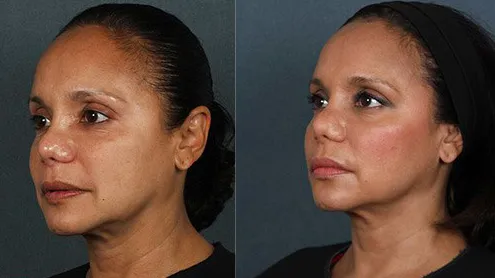
The first is immediate. By the end of the session, the lifted tissue position is already established. The face looks more defined, the jawline is clearer, and mid-face heaviness is reduced. This is the mechanical effect of the bi-directional cones repositioning tissue.
The second phase is progressive. Over 4 to 12 weeks following treatment, the collagen stimulation response develops. The skin becomes progressively firmer and more resilient. Patients typically notice that the quality and texture of the skin also improve during this period as the new collagen matrix forms around the thread sites.
Most patients find the 8 to 12 week result more satisfying than the immediate post-treatment result, as the swelling has fully resolved and the collagen response has added a natural firmness that complements the physical lift.
Who Is the Right Candidate?
The Silhouette Facelift is most effective for patients who meet the following criteria:
- You have mild to moderate facial sagging, particularly in the mid-face, cheeks, jawline, or lower face, that is not adequately addressed by injectables alone
- Your skin retains a degree of elasticity sufficient for the lifted tissue to hold in its new position
- You want a visible structural improvement without surgery, general anaesthesia, or significant recovery time
- You are in good general health with no active skin infection or inflammation in the planned treatment area
- You are not pregnant or breastfeeding
- You are not taking anticoagulant medications that cannot be paused before treatment
- You have realistic expectations. The Silhouette system lifts and firms effectively for mild to moderate laxity; patients with advanced or severe sagging are better candidates for surgical correction
- You are 18 years of age or above
Benefits of the Silhouette InstaLift
- Provides an immediate, visible lift from the first session without surgery
- Stimulates the body's own collagen production for progressive improvement over 4 to 12 weeks
- Fully absorbable threads, no permanent foreign material left in the tissue
- No visible scars, stitches, or external dressings
- Minimal downtime, most patients return to normal activity within a few days
- Local anaesthetic only, no general anaesthesia required
- Results last 12 to 18 months and can be maintained with follow-up treatment
- Customisable thread count, placement pattern, and lifting vectors are specific to your anatomy
- FDA-cleared and CE-marked, with established regulatory approvals in major markets
- Can be combined with dermal fillers or neuromodulators for a more comprehensive rejuvenation outcome
Understanding Potential Side Effects
The Silhouette Facelift is a safe, well-tolerated procedure when performed by a specialist with appropriate training. The following side effects are categorised by frequency and expected duration:
Expected in the first week:
- Swelling and mild bruising at entry and exit points resolve within 5 to 10 days
- A sensation of tightness in the lifted areas is normal as tissue adjusts to its new position; it gradually settles over 1 to 2 weeks
- Minor surface irregularities or dimpling temporary, typically smoothing out within 1 to 2 weeks
- Temporary redness at needle entry sites resolves within a few days
Less common:
- Asymmetry between the two sides can occur if tissue responds differently; assessed at the two-week follow-up and addressed if needed
- Thread visibility or palpability beneath the skin is rare; more common if the thread is placed too superficially
- Infection at entry points is rare; managed with appropriate antibiotic treatment
Contact your clinic promptly if you experience escalating pain, significant asymmetry that is worsening rather than improving, fever, or any sign of infection at the needle entry sites.
Why Choose Us for Your Silhouette Facelift in Abu Dhabi?
Thread lift outcomes are determined largely by the placement precision and anatomical knowledge of the specialist performing the procedure. Incorrect thread depth, angle, or vector produces asymmetry, surface irregularity, or inadequate lift. Our clinic applies the clinical rigour and facial anatomy expertise this procedure demands.
- Board-certified plastic and facial surgeons with specific training and experience in the Silhouette Soft system
- Full facial anatomy assessment at every consultation, thread pattern and count are mapped to your specific tissue descent before any treatment begins
- Authentic Silhouette Soft product sourced directly through verified supply channels
- Transparent, itemised pricing confirmed before any treatment begins
- Comprehensive aftercare guidance and follow-up appointment included
Book Your Consultation in Abu Dhabi
If you want to lift and redefine your facial contours without surgery, a consultation is the right starting point. Your specialist will assess your facial anatomy, determine whether a Silhouette Facelift is the most appropriate treatment for your degree of laxity, and build a treatment plan with a realistic thread count and outcome expectation.
Book online, call us directly, or visit our clinic in Abu Dhabi to get started.